Why AI sounds sure even when it's wrong
Once you understand it, you'll know which answers to double-check, why the same question gets different answers, and how AI can sound certain even when it's guessing.
September 2026
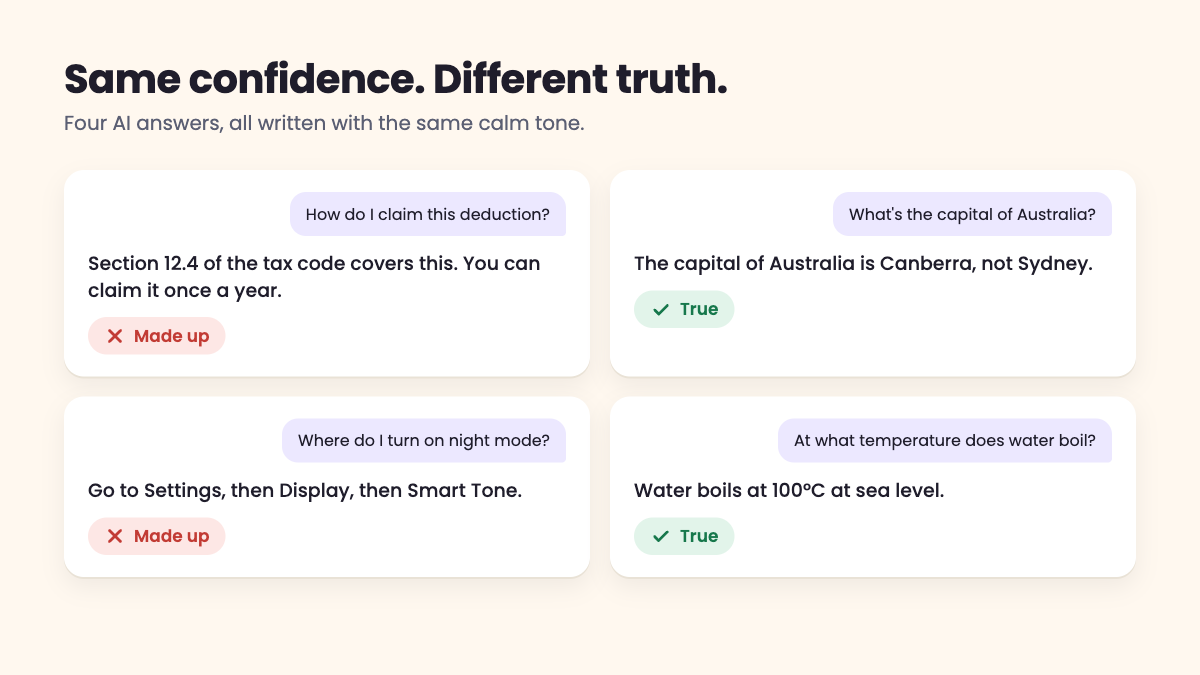
You ask an AI to explain a tax rule and it quotes a section number that doesn't exist, you ask where a setting is on your phone and it describes a menu your phone doesn't have, or you ask for a source for your report and the link leads nowhere.
Each answer came instantly, well written and calm, but nothing in it hinted that this one was different from the hundreds of correct answers it had given you before.
Why this matters to you
We now use AI for real decisions like emails to clients and questions about health, money and work, so getting an answer is the easy part, and knowing which answers to trust is where it gets hard.
Inside every AI model there's a number for exactly that, called a confidence score, which tracks how sure the model is about what it's saying and shapes every answer you get.
Once you understand it, you'll know which answers to double-check, why the same question gets different answers, and how AI can sound certain even when it's guessing.
What a confidence score actually is
In practice, a confidence score is a probability, which means a number between 0 and 1, or 0% and 100%.
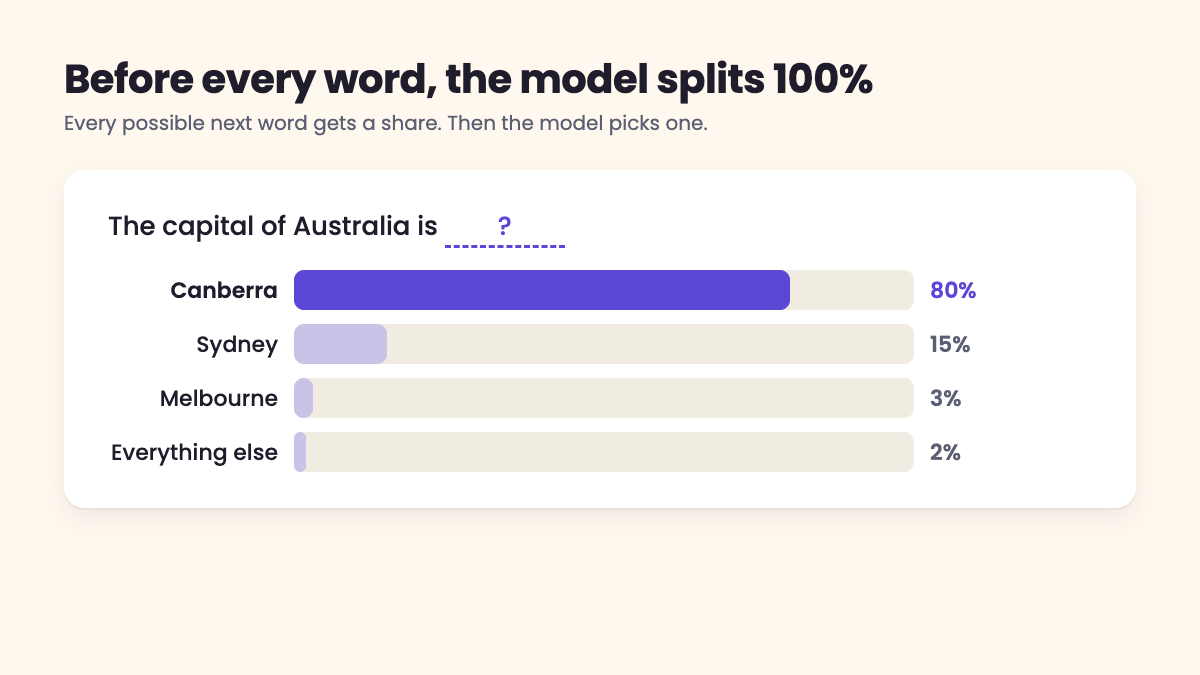
Chatbots write one word at a time, and before each word the model scores every word it knows and turns those scores into percentages that add up to 100%. This step is called softmax, where every option gets a share of the model's belief and the model picks from them.
For example, for "The capital of Australia is", the model might give "Canberra" around 80%, "Sydney" 15% and tiny shares to thousands of other words, and developers can actually see these numbers through some AI tools, where they're called log probabilities.
How to read a confidence score
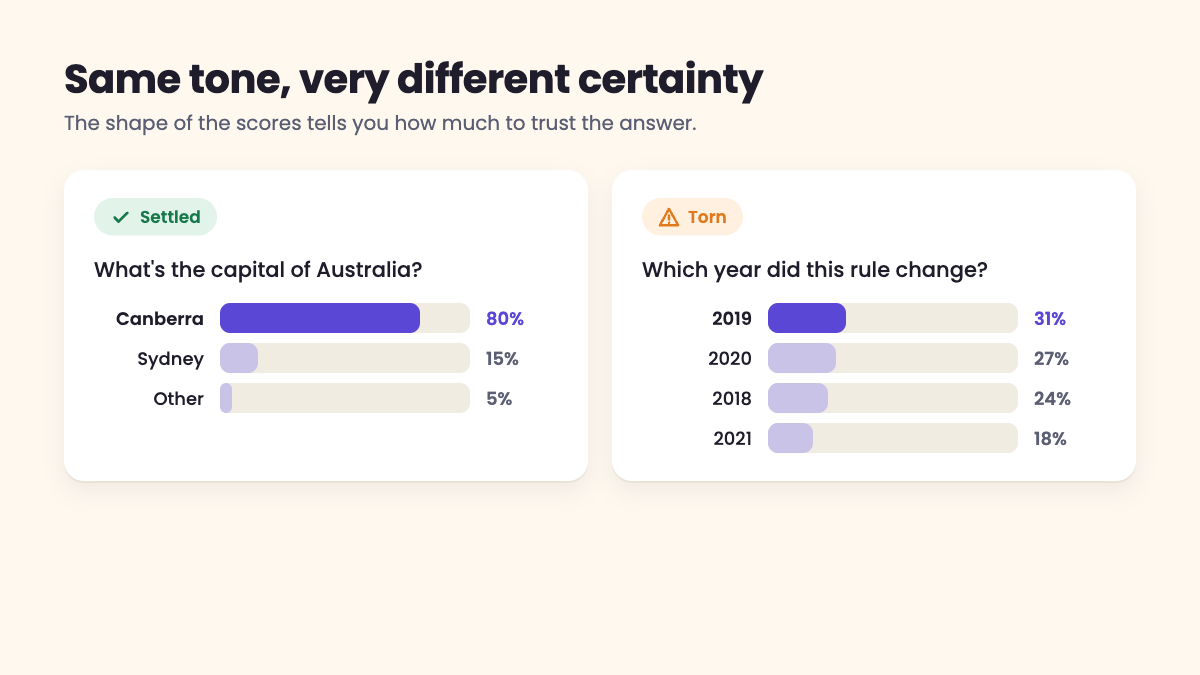
The spread matters more than the top number, because when one option takes almost all the probability the model is settled, and when the probability is split across several options the model is torn.
For you, a torn model means the answer could easily have gone another way, but the model still has to pick one and it writes that pick in the same even tone.
Why you get a different answer when you ask again
A chatbot doesn't always pick the top word, it picks at random weighted by the percentages, so a word at 15% gets chosen roughly 15% of the time.
A setting called temperature controls how adventurous this is, where low temperature sticks close to the top choice and high temperature takes more chances.
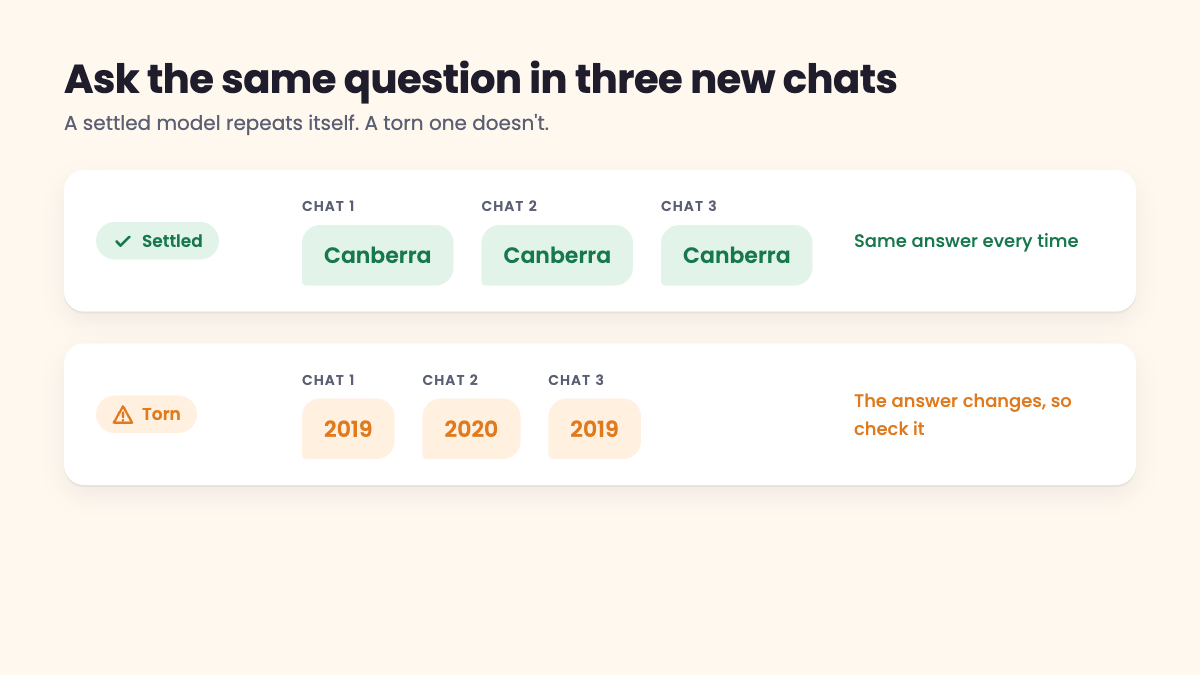
This gives you a free test, because a settled model lands on the same answer almost every time while a torn one lands on different answers in different chats.
Why AI can sound certain while it's guessing
There are three things that hide the model's real confidence from you.
The tone is learned. AI learned to write from human text, and since most human text states things plainly, every answer comes out in that style no matter what score sits behind it.
Chat apps show no score. A long answer is built from hundreds of word choices, each with its own percentage, so there's no single number for the whole thing, and asking "how sure are you?" won't reveal it either because the model writes that reply the same way it writes everything else.
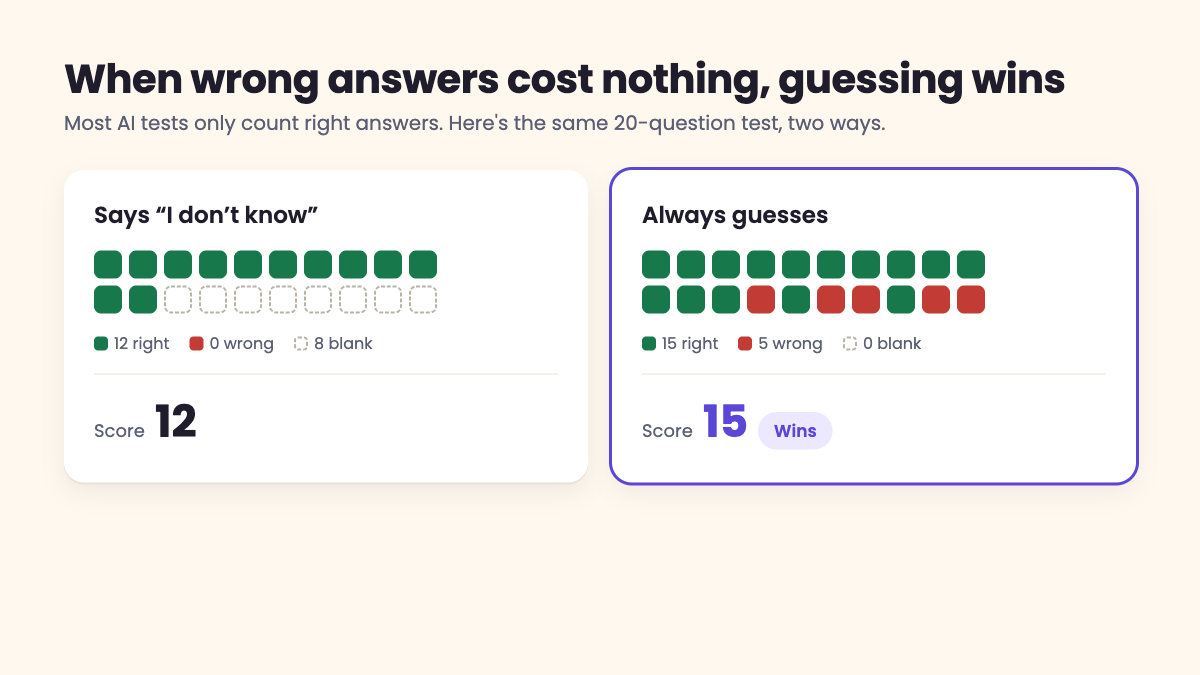
Training rewards guessing. Models are tested a lot like students on multiple choice exams, where a blank scores zero and a guess might score a point, and in 2025 OpenAI researchers argued that this pushes models to guess. A model that guesses someone's birthday has a 1 in 365 chance of scoring while "I don't know" never scores, and OpenAI also reported that polishing GPT-4 into a friendly assistant made it more overconfident.
How apps you already trust handle uncertainty
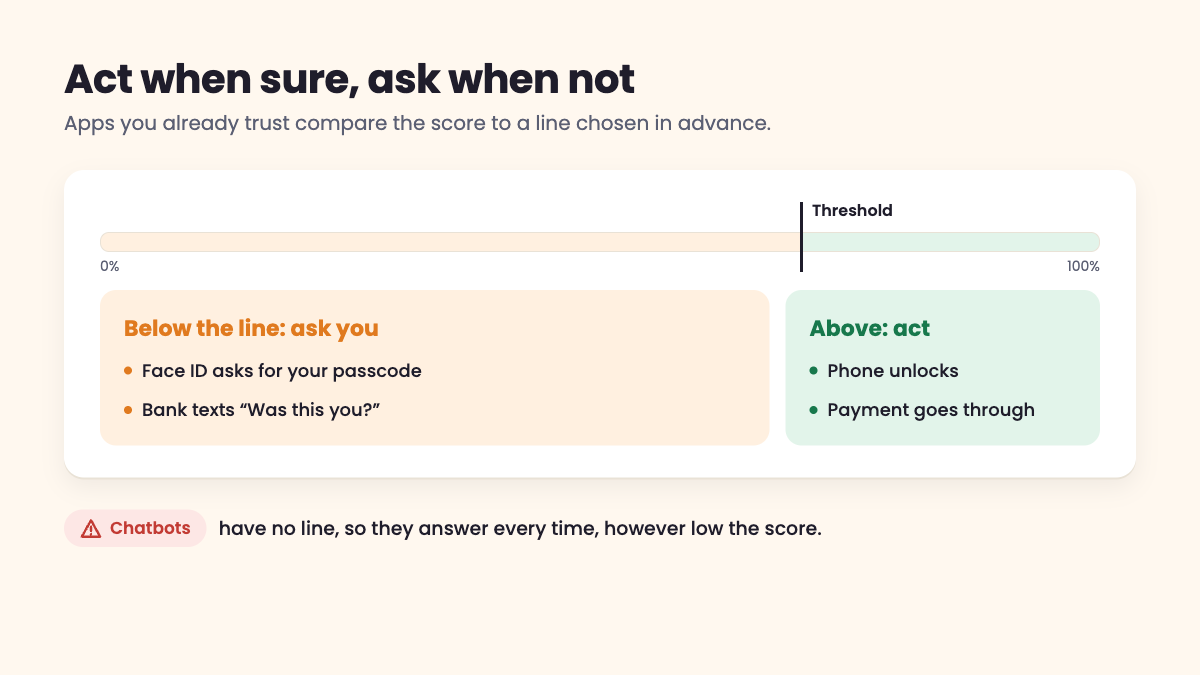
Apps that use confidence well pair the score with a threshold, which is a line chosen in advance, so above it the app acts on its own and below it the app checks with you.
Face ID unlocks when it's sure it's you and asks for your passcode when it isn't, and your bank approves most payments silently but texts "Was this you?" when one looks unusual.
Choosing that line is a real tradeoff, since a higher line means fewer mistakes but more interruptions, and a lower line feels smoother but lets more wrong calls through. Chatbots don't have a line like this, so they answer every question however low the score is.
When you can trust a confidence score
A score is only useful if it's honest, and checking that is called calibration.
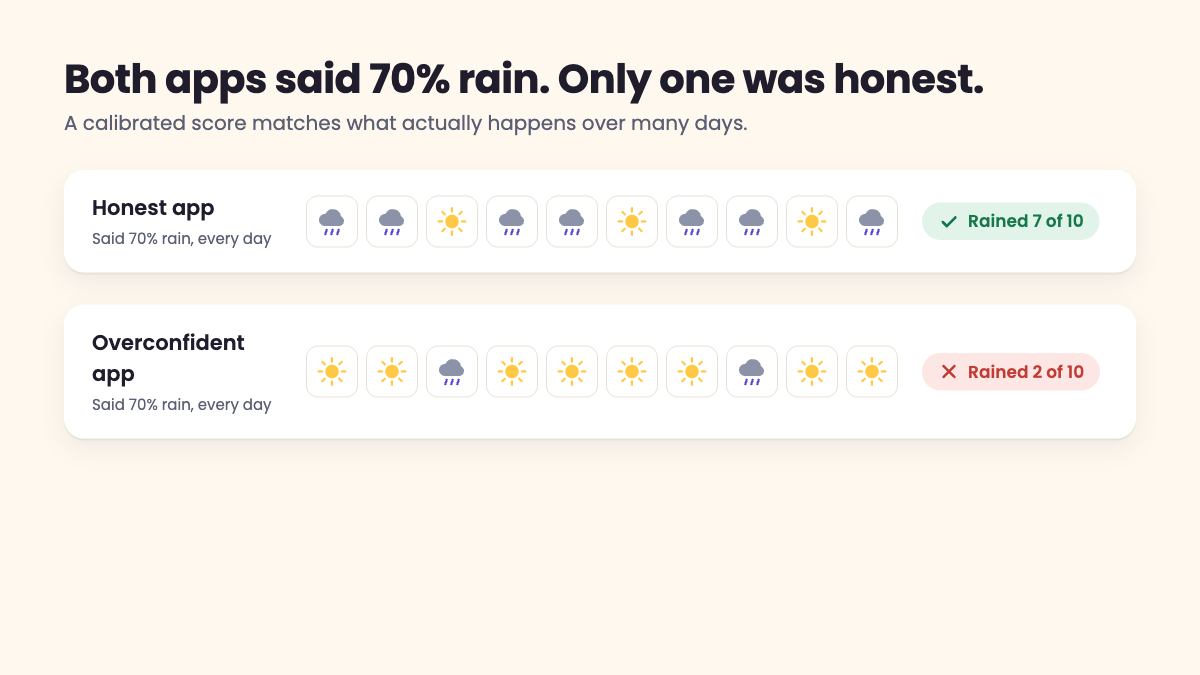
Your weather app shows the idea well, because if it says 70% chance of rain on ten days it should rain on about seven of them, and if it rains on only two, its 70% really means "probably not."
Teams test AI the same way by grouping answers by confidence and checking how often each group was right, and the result can change with the topic, so a model can be well calibrated on general knowledge but overconfident on niche subjects.
How to spot a confident wrong answer
You can't see the score, but you can still work around it.
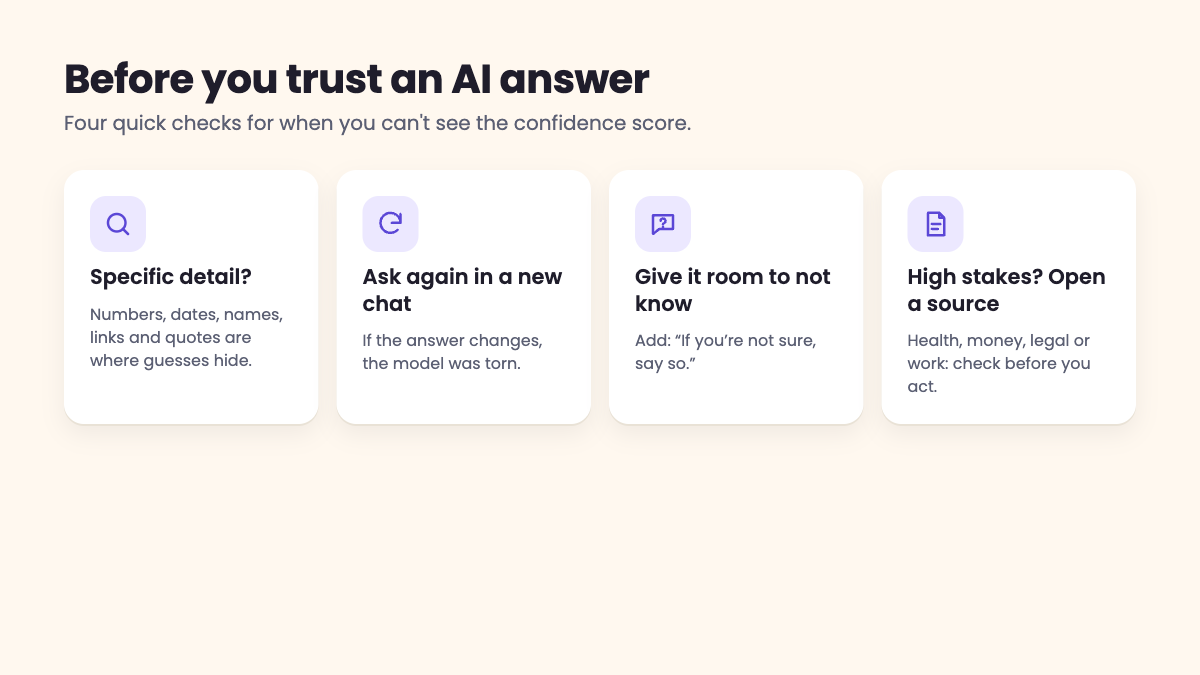
Be careful with specific details. Exact numbers, dates, names, quotes, links and section numbers are where torn models guess the most, and the same goes for recent events and niche topics.
Ask again in a new chat. If the answer changes, the model was torn, so trust neither version.
Give it room to not know. Adding "If you're not sure, say so" pushes against the habit of guessing and makes an honest "I don't know" more likely.
Check a source when it matters. For health, money, legal or work decisions, open a real source before you act on anything.
Next time an answer sounds sure
Think back to the section number that didn't exist, the missing phone menu and the dead link, because each of them was most likely a guess from a torn model, written in the same easy style as a correct answer.
The model's real confidence lives in numbers the app never shows you, and a detail check, a second chat and a quick source are how you get that signal back.
Sources
- Why language models hallucinate, OpenAI, 2025
- GPT-4 Technical Report, OpenAI, 2023
- Model Calibration, Explained: A Visual Guide, Towards Data Science